The Hidden Cost of Coordination Waste
Written by Peter Luff, Director at VISION Consulting.
Adapted from concepts developed by Chauncey Bell in Notes on Identifying and Assessing the Economic Consequences of Coordination Waste, updated for the context of current organisational performance, operational effectiveness, and coordination across complex enterprises.
The Hidden Cost of Coordination Waste
Most organisations are highly focused on visible costs; technology investments, operational spend, productivity targets, and process efficiency. Yet some of the most significant losses inside modern businesses remain largely invisible.
They sit in the gaps between teams, decisions, systems, and conversations.
This is coordination waste: the hidden organisational friction that slows execution, creates duplication, weakens accountability, and ultimately impacts both customer experience and business performance.
Unlike traditional operational inefficiencies, coordination waste rarely appears clearly in financial reporting. It accumulates quietly through delayed decisions, unclear ownership, repeated work, unnecessary complexity, and poor communication between functions. Over time, these issues become embedded in the way organisations operate and are often accepted as “just how things are around here.” But the cost is substantial.
The Nature of Modern Organisational Waste
Historically, organisations concentrated on reducing physical and operational waste – streamlining production, improving utilisation, and eliminating inefficiencies in process and supply chains. As businesses became more digital, the focus shifted toward information management and technology enablement.
Today, however, many organisations face a different challenge altogether: how effectively people coordinate with one another in increasingly complex environments.
Traditional productivity models focused primarily on physical and process inefficiencies. Increasingly, however, organisations are recognising the operational impact of coordination and behavioural waste across teams, functions, and decision-making structures.
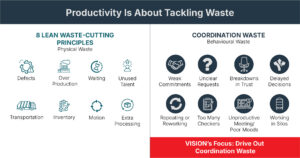
While lean methodologies helped organisations improve operational efficiency, current performance challenges now stem from the quality of coordination across the enterprise. Delayed decisions, unclear accountability, siloed working, excessive oversight, and rework often create hidden friction that slows execution and reduces organisational agility.
In practice, some of the greatest barriers to performance are no longer technical. They are relational and organisational.
When Coordination Breaks Down
When teams are misaligned, work slows down. When expectations are unclear, effort is duplicated. When communication breaks down, decisions take longer and problems escalate unnecessarily. Many organisations spend significant energy managing internal friction rather than creating value.
This becomes particularly visible in large or fast-moving organisations where multiple teams contribute to shared outcomes. Projects stall not because capability is lacking, but because coordination becomes fragmented across functions, priorities, and reporting structures.
Over time, organisations often respond to this friction by adding more controls, more approvals, more reporting layers, and more governance mechanisms. While these structures are usually introduced with good intentions, they frequently create additional complexity that slows responsiveness and weakens agility.
The result is an organisation that appears busy but struggles to move efficiently.
The Quality of Conversations Matters
One of the most overlooked dimensions of coordination waste is the quality of organisational conversations. High-performing organisations tend to create clarity around commitments, ownership, and expectations. People understand what has been agreed, who is responsible, and what success looks like.
In lower-performing environments, commitments are often vague or assumed rather than explicit. Work progresses on the basis of partial alignment, unclear expectations, or incomplete communication. This creates the need for constant follow-up, escalation, rework, and clarification, all of which consume time and energy without creating additional value.
Strong coordination is not only about process design. It is also about how effectively people communicate, listen, align, and follow through.
Trust as an Operational Advantage
Trust is often discussed as a cultural value, but it also has direct operational and economic consequences.
Low-trust environments naturally generate defensive behaviours. Teams create additional oversight, duplicate controls, and escalate decisions unnecessarily because confidence in coordination is weak. Energy becomes focused on protection and verification rather than delivery and problem-solving.
By contrast, organisations with stronger trust and clearer communication are typically able to make decisions faster, collaborate more effectively, and adapt more quickly when priorities shift.
Trust reduces friction.
Asking Better Questions
Some of the most valuable organisational questions are surprisingly simple:
- Where do decisions consistently slow down?
- Where does work need to be repeated or corrected?
- Where are teams misaligned on priorities or outcomes?
- Where do customers experience unnecessary friction?
- Which processes no longer add meaningful value?
- These questions often reveal issues that traditional operational reviews miss.
Coordination as a Competitive Advantage
Coordination waste cannot be eliminated entirely. Every organisation will experience friction as priorities evolve and complexity increases. However, organisations that learn to recognise and reduce unnecessary coordination waste create meaningful advantages.
They move faster.
They collaborate more effectively.
They improve customer outcomes.
And they create environments where people can focus more energy on contribution rather than navigation.
In an increasingly complex business environment, organisational performance depends not only on strategy, technology, or process excellence, but on the quality of coordination across the enterprise.
The hidden costs are often the ones that matter most.
Most organisations recognise the symptoms of coordination waste; delayed decisions, duplicated effort, siloed working, and increasing operational complexity but struggle to identify where the underlying friction truly sits.
VISION Consulting works with organisations to uncover the hidden barriers impacting delivery, alignment, and performance across complex programmes, projects, and operational environments.
If these challenges resonate with your organisation, contact Peter Luff, Director at VISION Consulting, at pluff@vision.com to explore how improving coordination can accelerate delivery, strengthen organisational performance, and unlock greater operational effectiveness.